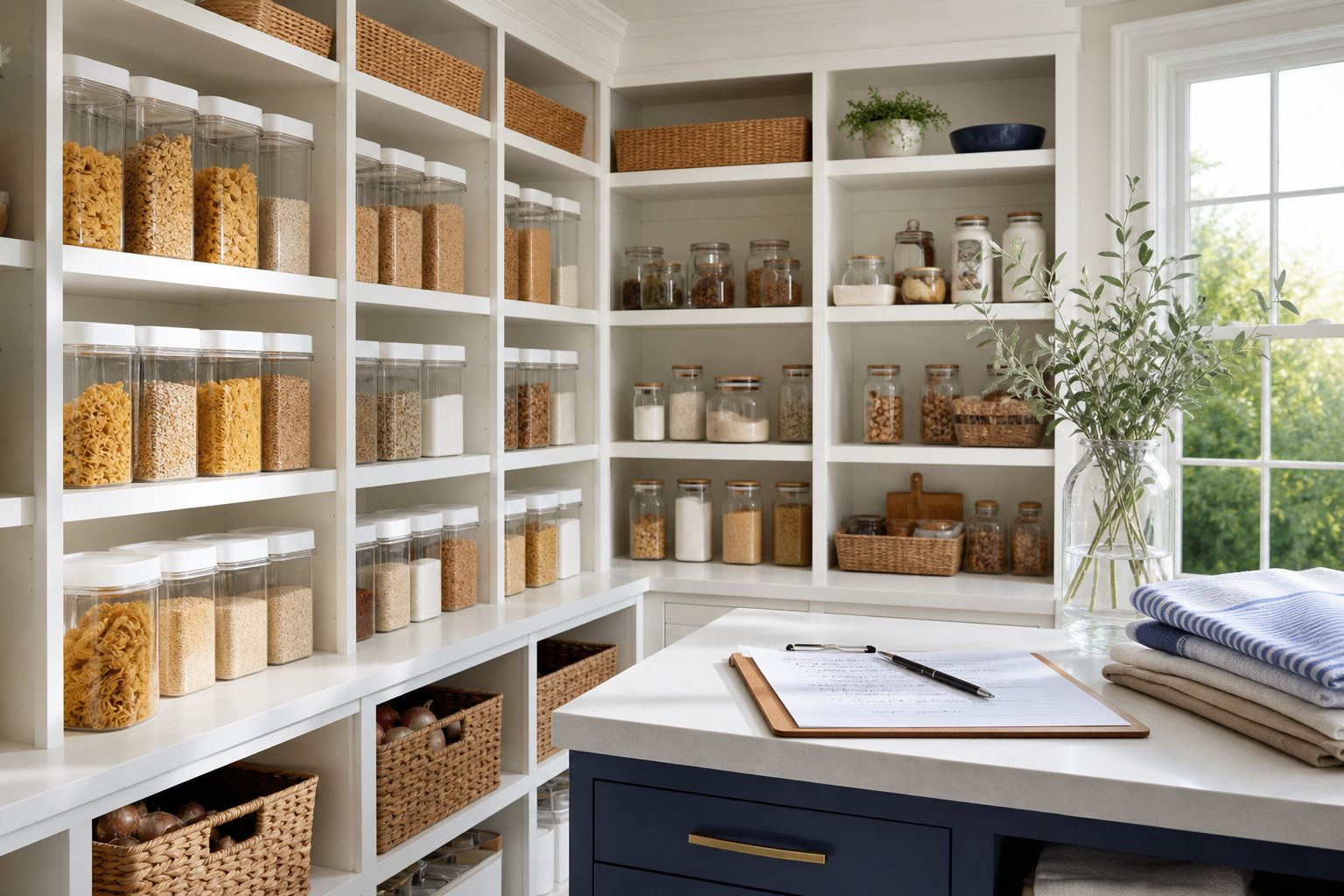
In your first year, a full pantry organizing project in most US metros lands somewhere between $600 and $1,800 in labor, before any product. That is a wide band because a pantry is not one thing. A reach-in closet with four shelves and a family of two is a half day. A walk-in with a chest freezer, a baking station, three kinds of flour and a decade of grocery rotation is two days with a helper.
The number that matters is not the total. It is your hourly yield: labor revenue divided by every hour the job actually consumes, including the consult, the sourcing, the drive and the returns. Organizers who price badly in year one usually price fine on paper and then quietly lose four unbilled hours per project to shopping and hauling.
So the honest answer is this. Estimate the hours from countable features of the pantry, apply a floor rate you built from your own overhead, add the hours nobody sees, then decide separately how product money flows. Those are four independent decisions, and mixing them is what makes a quote impossible to defend when the client pushes back.
The three pricing models organizers use and what each hides
Almost every organizing business in the US uses one of three structures, or some blend. Each one is a bet about who carries the risk of the unknown.
Straight hourly
You bill a rate per organizer hour, often with a session minimum of three or four hours. The client carries all the risk. Your risk is different and sneakier: you are paid only for time in the house, so consult time, sourcing time, label production and the donation run come out of your margin unless you explicitly bill them.
Package or session block
You sell blocks, for example a 12 hour package used across three sessions, usually at a small discount off the hourly rate. This smooths your calendar and gets cash in early. What it hides is that clients treat a block as a guarantee of completion. If the pantry is not finished at hour 12, you are having a conversation you did not budget for.
Flat project fee by zone
You scope the pantry as a zone, quote one number, and take the risk of your own estimate. This is where experienced organizers end up, because it sells an outcome rather than a clock, and because it lets you get faster without getting poorer. It only works if your hour estimate is built from something countable and if your contract has a change order clause.
Keep reading: What do I actually need to do before I let a client's clutter into my own vehicle?
Estimating hours for a pantry: linear feet, category count, decant load
Guessing hours by feel is how first year quotes go wrong. Count three things at the consult instead.
Linear shelf feet. Measure the usable shelf run, not the room. A reach-in with five shelves at 4 feet wide is 20 linear feet. A walk-in with three walls of shelving can easily hit 60.
Category count. Walk the space and name the groupings the client will need: baking, breakfast, canned goods, snacks, pasta and grains, oils and vinegars, paper goods, small appliances, pet, medicine. A pantry with 8 categories sorts fast. One with 20 needs a plan drawn before a single item moves.
Decant load. Count the items that will be transferred out of packaging into containers. Decanting is the slowest task in a pantry and the one clients most underestimate. Flour, sugar, rice, pasta, cereal, coffee, pet food, snacks in bulk.
Here is a working estimate frame. These multipliers are my planning assumptions, not measured research, and you should adjust them against your own logged times after five jobs.
| Task | Planning assumption | Example: 40 linear feet, 14 categories, 30 decants |
|---|---|---|
| Empty, sort, purge | 0.15 organizer hours per linear foot | 6.0 hours |
| Clean shelves and liner | 0.05 per linear foot | 2.0 hours |
| Category planning and zoning | 0.2 hours per category | 2.8 hours |
| Decant and fill | 4 minutes per container | 2.0 hours |
| Labeling | 3 minutes per label, plus 45 min design | 2.3 hours |
| Staging, styling, walkthrough | Flat | 1.0 hour |
| On site total | 16.1 organizer hours |
Sixteen organizer hours is two people for one full day plus a short second morning. Now add the off site hours, because that is where the first year margin dies: consult and proposal 1.5, sourcing and ordering 2.0, label file and printing 0.75, returns and donation run 1.5. That is 5.75 more hours, a 36 percent uplift on the on site figure.
Where product spend sits: pass through, markup, or client purchased
Containers, bins, risers, turntables, liner, labels. On a real pantry this is frequently $400 to $1,500, and how you handle it changes your business more than your hourly rate does.
- Client purchased. You send a list, they buy it. Zero cash risk, zero margin, and you inherit the problem of the wrong bins arriving in the wrong size the morning of install.
- Pass through at cost. You buy, you invoice the receipts. You control what shows up. You are now floating their money on your card and doing the returns for free. If you do this, bill a procurement fee for the sourcing hours, stated as a fee, not hidden.
- Markup. You buy at retail or at a trade account price and resell at a stated markup, commonly 15 to 25 percent. This is legitimate and normal in the trade, but it must be disclosed in the proposal, and you should check whether your state expects you to collect and remit sales tax on the resale of tangible goods. A reseller permit is a state level thing. Ask a CPA in your state before your first marked up invoice, not after.
Whichever you choose, write it in the proposal in one plain sentence and never let product spend get blended into the labor number. A client who cannot see the split will assume your labor is the expensive part.
Keep reading: Should I quote by the zone or by the hour when a client wants the whole house done?
Travel, hauling, and donation runs as billable line items
These are the three quiet leaks.
Travel. Set a radius that is included, say 20 miles from your base, and a per mile charge beyond it. The IRS standard mileage rate for business use is published each year and is a defensible reference point for what a mile costs you. Look up the current year's rate rather than reusing a number you remember.
Hauling. Moving a client's discards in your own vehicle carries real insurance and liability questions. Price it as a distinct line, or decline it and refer a junk removal service that bills the client directly.
Donation runs. Bill the hour and the mileage. Give the client the receipt from the charity and let them handle valuation with their own tax preparer. You should never assign a dollar value to donated goods on the client's behalf.
Building your floor rate from real overhead, not from what others post
Screenshots of other organizers' rates tell you nothing about their cost structure. Build yours.
Start with billable capacity. Assume you work 46 weeks and can sustain 18 on site organizer hours a week without burning out, because the rest goes to sourcing, admin, marketing and consults. That is 828 billable hours a year.
Now list annual costs. Say general liability insurance $700, commercial auto or a business use endorsement $1,400, software and website $900, label supplies and consumables $600, marketing $2,400, accounting $900, vehicle running costs $3,000, phone $600. That is $10,500 of overhead. Divide by 828 and your overhead alone is $12.68 per billable hour.
Decide what you need to take home. If you want $65,000 of owner pay, and you set aside 25 percent for self employment tax and income tax, you need roughly $86,700 of gross pay. Add the $10,500 overhead: $97,200. Divided by 828 hours, your break even rate is $117 per hour. Below that you are subsidizing the client.
Those inputs are illustrative. Substitute your real insurance quote, your real mileage, your real target pay, and rerun the same four lines. The point is that your floor is arithmetic, not opinion.
Apply it to the pantry above: 16.1 on site hours at $117 is $1,884, and the 5.75 off site hours need to be covered either inside that number or as stated fees.
See how TidyBlueprint handles this for professional home organizing
Raising the number between year one and year three
You will get faster. The trap is letting speed convert into a pay cut, which is exactly what happens on straight hourly. Three moves, in order.
- Log everything for ten projects. Actual start and stop times, linear feet, categories, decant count, sourcing hours, returns. Ten data points beat any benchmark you read.
- Move from hourly to flat zone pricing once your estimates land within 15 percent. Now speed is yours. A pantry you used to do in 16 hours and now do in 12 pays you the same and frees a half day.
- Raise the floor rate on new clients only, at a set date, in writing. Existing clients keep their rate through their current signed plan. Nobody feels ambushed.
By year three the same pantry may quote at $2,400 flat with product handled at a disclosed markup, and you finish in a day and a half with a helper. Nothing about the room changed. Your estimating did.
Where to take this next
The reason first year pricing feels like guesswork is that the estimate lives in your head and the proposal lives in a document that does not know about the estimate. TidyBlueprint closes that gap: you scope the pantry as a zone at the consult, count the linear feet and the decants, get an hour estimate and a product list attached to the same plan, and hand the client a priced project they can sign before you leave the driveway. Then the before and after record and your actual hours feed straight back into the next quote.
Start with your own numbers. Build the floor rate this week, log your next five pantries against the task table above, and let the third quote be the one you stop apologizing for.