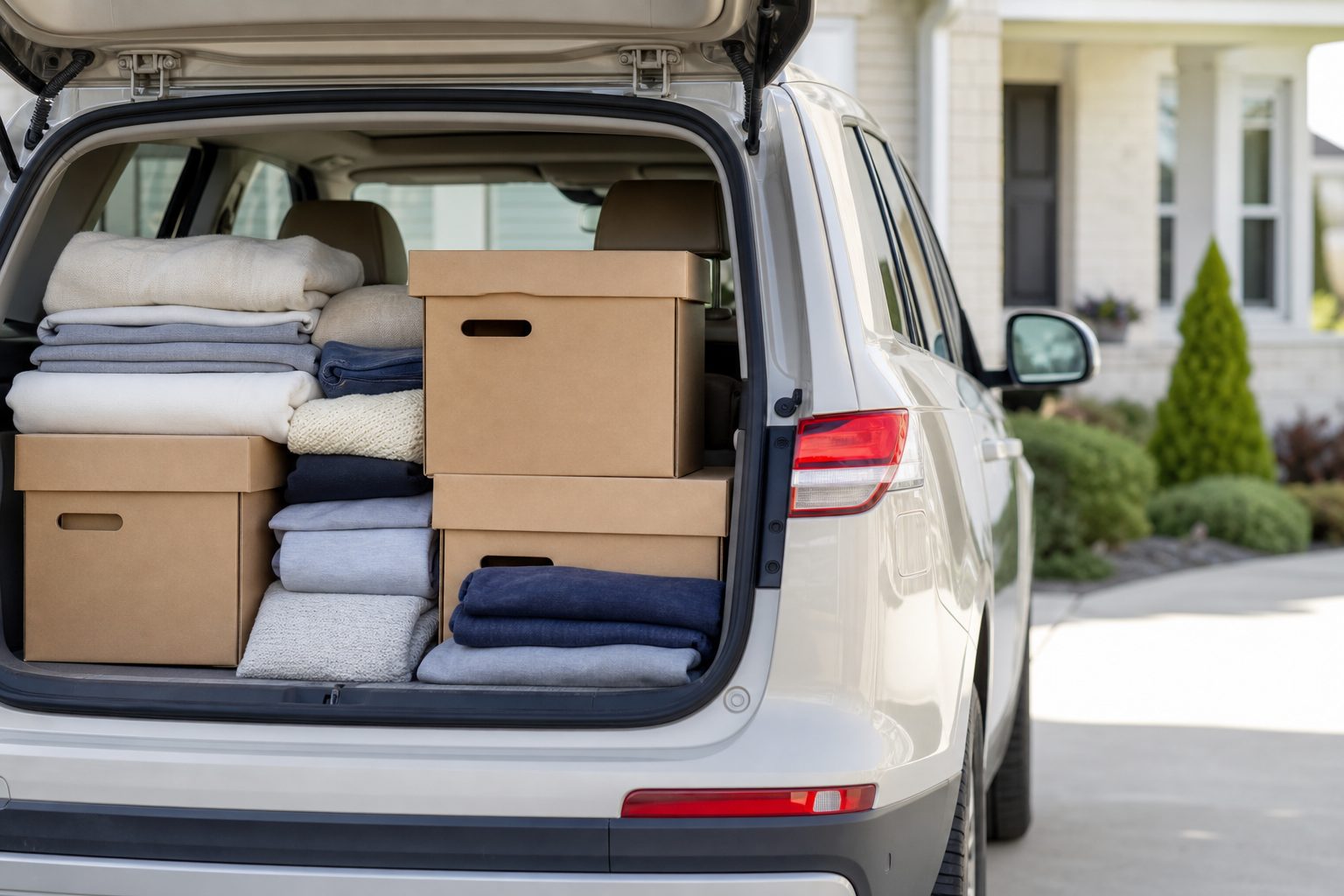
Before a single bag of a client's discards goes into your car, you need three things: an auto policy that knows you are using the vehicle for business, a written record of what left the house with the client's signature on it, and a clear line about what you will not transport. Everything else is refinement.
The reason is simple and unglamorous. A personal auto policy is written for personal use. The moment the trip exists because you were paid to be there, an insurer has grounds to look hard at the claim. And the goods in your back seat are not yours, which means if they are lost, damaged or stolen, you are holding someone else's property with no coverage that automatically follows it.
None of this means you should stop doing donation runs. Removal is often the part of the job the client values most. It means you should carry the risk deliberately, priced and documented, instead of accidentally.
Where a personal auto policy stops covering business use
Personal auto policies generally cover commuting and personal errands. Most contain language that excludes or limits use of the vehicle in a business, with a common carve out for private passenger use by the named insured. The exact wording varies by carrier and by state, which is why the only reliable move is to read your own declarations page and endorsements and then call the carrier.
What tends to draw scrutiny after an accident is a pattern, not a single trip. Regular loaded trips, a business name on the vehicle, invoices showing hauling charges, a client who tells the adjuster you were working. Adjusters investigate. If the use was business and the policy excluded it, a denial is possible, and a denial means the repair, the other driver's damage and any injury claim land on you personally.
There is a middle option many organizers do not know about. Some carriers will add a business use classification or an endorsement to a personal policy for a modest premium increase, particularly for a sole proprietor using one vehicle for light business travel. Ask specifically: does this endorsement cover transporting client owned property, or only my travel to and from job sites? Those are very different answers, and the second one is the one that leaves you exposed.
Keep reading: Should I quote by the zone or by the hour when a client wants the whole house done?
Commercial auto versus hired and non-owned coverage for organizers
Three products come up. They solve different problems and organizers regularly buy the wrong one.
| Coverage | What it is for | Fits you when |
|---|---|---|
| Commercial auto | Vehicles owned by or titled to the business, or a personal vehicle used substantially for business | You haul regularly, the van is the work vehicle, you may add employees who drive it |
| Hired and non owned auto (HNOA) | Liability when you or your team drive rented or personally owned vehicles for business | Your assistant uses her own car for donation runs, or you rent a cargo van for big installs |
| Inland marine or bailee coverage | Property of others in your care, custody and control, including while in transit | Always, if client goods ride in your vehicle. Auto liability does not cover the cargo. |
The third row is the one that surprises people. Auto liability pays for the harm you do to other people and their property. It does not pay to replace the client's grandmother's china that was in a bin in your trunk. That is a property of others exposure, and general liability policies often exclude it too, which is why bailee or care custody and control coverage exists as an add on. Ask your broker for it by name.
HNOA is usually cheap and is the correct answer if you have even one helper who drives her own car with client goods in it. Without it, an accident on a donation run is her personal policy's problem first and your business's problem second, and she will not enjoy discovering that.
When hauling becomes regulated waste transport in your state
Donation drop off is not waste hauling. But some of what leaves a decluttered house is not donatable, and that is where rules start applying.
Three categories change the picture.
- Solid waste for disposal. Several states and many counties license or permit businesses that transport solid waste for hire. If you are charging to remove trash and take it to a transfer station or landfill, check your state environmental agency and your county solid waste authority. The threshold is often about being paid to haul, not about volume.
- Household hazardous waste. Paint, solvents, pesticides, pool chemicals, motor oil, propane cylinders, some cleaning products. These have specific disposal channels, usually a county HHW collection site or event. Transporting them in quantity for hire can trigger a different regulatory tier entirely. Practical rule: leave them for the homeowner to take, or schedule the county pickup and be present for it.
- Electronics and batteries. Many states have e-waste laws restricting landfill disposal of monitors, TVs and lithium batteries. There is usually a designated recycler. Lithium batteries in a hot vehicle are also a genuine fire risk, not a theoretical one.
The other item that stops the truck is anything with personal data or a medical component: old hard drives, prescription medications, sharps. Meds go to a pharmacy or law enforcement take back, not your car.
Keep reading: How do I run a consult so the client signs the plan before I leave the house?
Donation receipts, valuation, and why you never assign the value
The tax deduction belongs to the client. Your job is to make it possible for them to claim it correctly, not to calculate it.
The receipt the charity issues is typically a blank acknowledgment: it names the organization, the date and a general description of the goods, and it does not state a value. That is intentional. Under IRS rules for noncash charitable contributions, determining fair market value is the donor's responsibility, and larger donations carry additional requirements, including a qualified appraisal above certain thresholds. Direct the client to Form 8283 and their own tax preparer.
Never write a dollar figure on a donation list on the client's behalf. If they ask, and they will, the sentence is: "The charity issues the receipt, and your tax preparer sets the value. I document exactly what went and where it went so you have the record."
What you should give them, same day:
- A photo of the loaded vehicle or the staged donation pile before it leaves.
- An itemized list by category and count, for example 4 bags women's clothing, 1 box kitchen small appliances, 2 bags linens.
- The name and address of the receiving organization and the date.
- The scanned or photographed receipt from the charity.
Documenting what left the house and getting written client sign off
The single most common dispute in this trade is a client who, three weeks later, cannot find something and concludes it went in your car. Documentation is not paranoia. It is how you stay friends.
Build the routine into the session and it costs about ten minutes.
- Stage before you load. Keep, donate, sell, trash, and a fifth pile: decide later. Nothing leaves from the decide later pile.
- Photograph each pile. Wide shot plus one closer frame per category.
- Walk the client past the donate pile before it moves. Physically. Not a text message from the driveway.
- Get a signature or a dated text confirmation on the itemized list, with the words authorizing removal and disposal.
- Hold a grace window on high risk items if the client is hesitant: jewelry, documents, anything sentimental. A 72 hour hold box in their garage prevents nearly every regret.
Your service agreement should also carry a short clause: the client warrants they own the items and authorize removal, they are responsible for removing valuables and documents beforehand, and items designated for donation or disposal are not recoverable once removed. Have an attorney in your state review the agreement once. It is a one time cost against a recurring risk.
See how TidyBlueprint handles this for professional home organizing
Subcontracting the haul to a junk removal service instead
For a lot of solo organizers, the right answer is not to carry any of this. Refer a licensed junk removal or donation pickup service, have them bill the client directly, and stay out of the chain of custody for the bulky and the questionable.
Run the arithmetic on your own situation. Suppose commercial auto adds $1,100 a year over your personal policy, bailee coverage adds $350, and you do 30 donation runs a year at 1.5 hours each. That is $1,450 of premium plus 45 hours. At a $110 billable rate, those 45 hours have an opportunity cost of $4,950. If you bill $75 per run, you collect $2,250 against roughly $6,400 of cost and time. Those figures are illustrative, but the shape holds: light hauling rarely pays for itself.
What does pay is the hybrid. Carry small, clean, donatable loads yourself, four bags and a box, covered by a business use endorsement and bailee coverage. Subcontract anything bulky, hazardous, electronic, or worth more than you want to insure. Keep the hazardous categories on a written do not transport list you hand the client at the consult so it is never a surprise on install day.
Where to take this next
This all works if the removal plan is part of the project plan, not an afterthought at 4 p.m. when everyone is tired. In TidyBlueprint, the donate and haul decisions live inside the zone you scoped, with the itemized list, the photos and the client sign off attached to the same record as the before and after images, so the documentation exists without a separate ritual.
Do two things this month: call your auto carrier and ask the transporting client property question directly, and write your do not transport list. Those two items cover most of the exposure most organizers are carrying without knowing it.