Quote by the zone. On a whole home job, hourly is the safer number and the worse business, because it caps your income at your stamina, invites the client to watch the clock instead of the outcome, and gives you nothing to schedule a team against.
The caveat is real, though. Zone pricing only survives contact with an actual family if you can draw a boundary around a space, describe what done looks like inside it, and hold that line with a change order when the client opens a closet you never priced. Without those three things, zone pricing is just an underquote with better formatting.
So the useful comparison is not which model is superior. It is which failure mode you are equipped to manage. Hourly fails by eroding trust and capping growth. Zone fails by absorbing scope. Here is how each behaves on a real eight to twelve week whole home project.
What a zone actually is and how to draw the boundaries
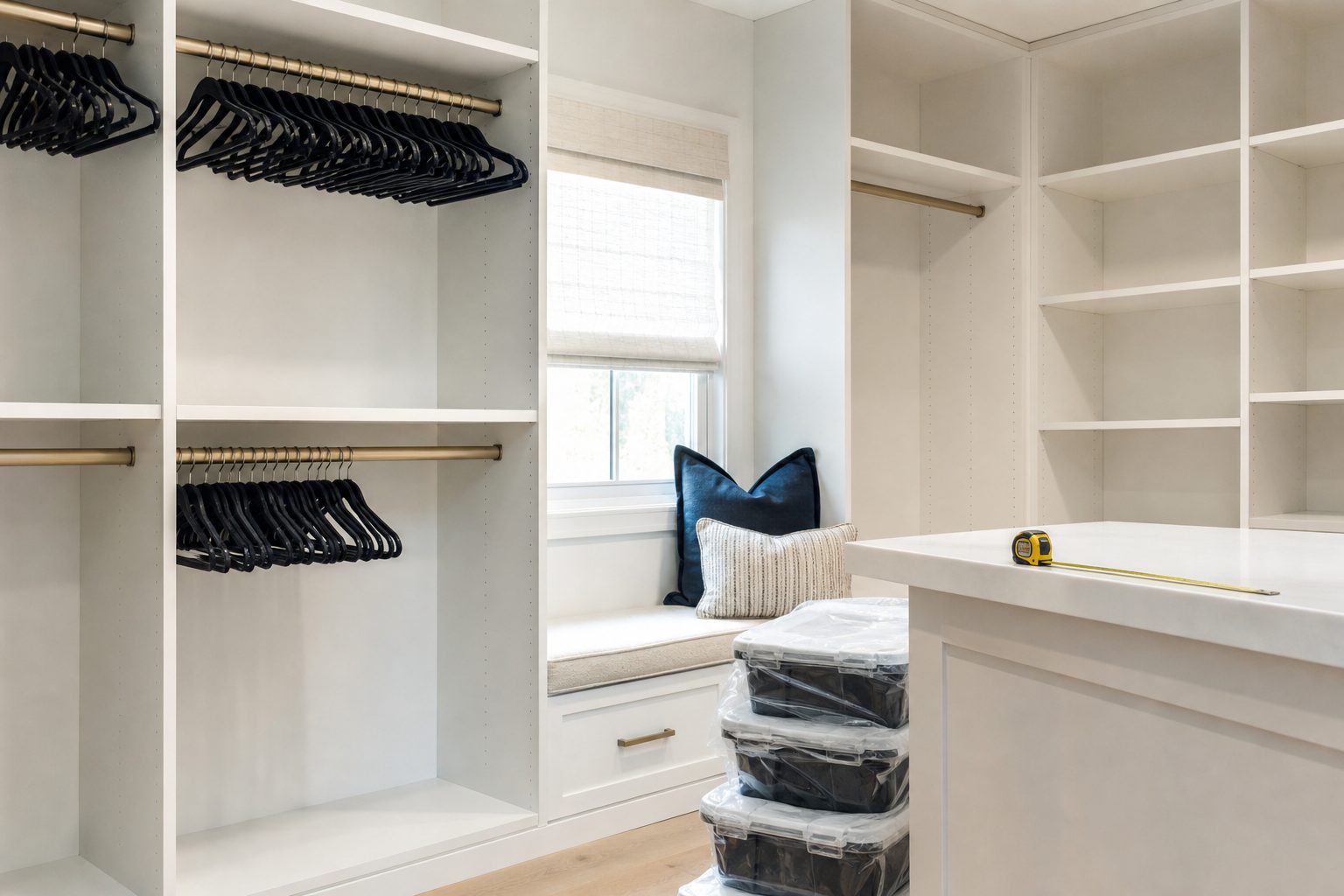
A zone is a physically bounded space with a single completion definition and its own product list. Not a room necessarily. A primary bedroom is often three zones: closet, dresser and nightstands, under bed and seasonal storage.
Draw the boundary with four questions at the consult.
- Can I close a door or point at a wall to define it? If the answer involves the phrase "and also whatever is in the hallway," you have not drawn a zone.
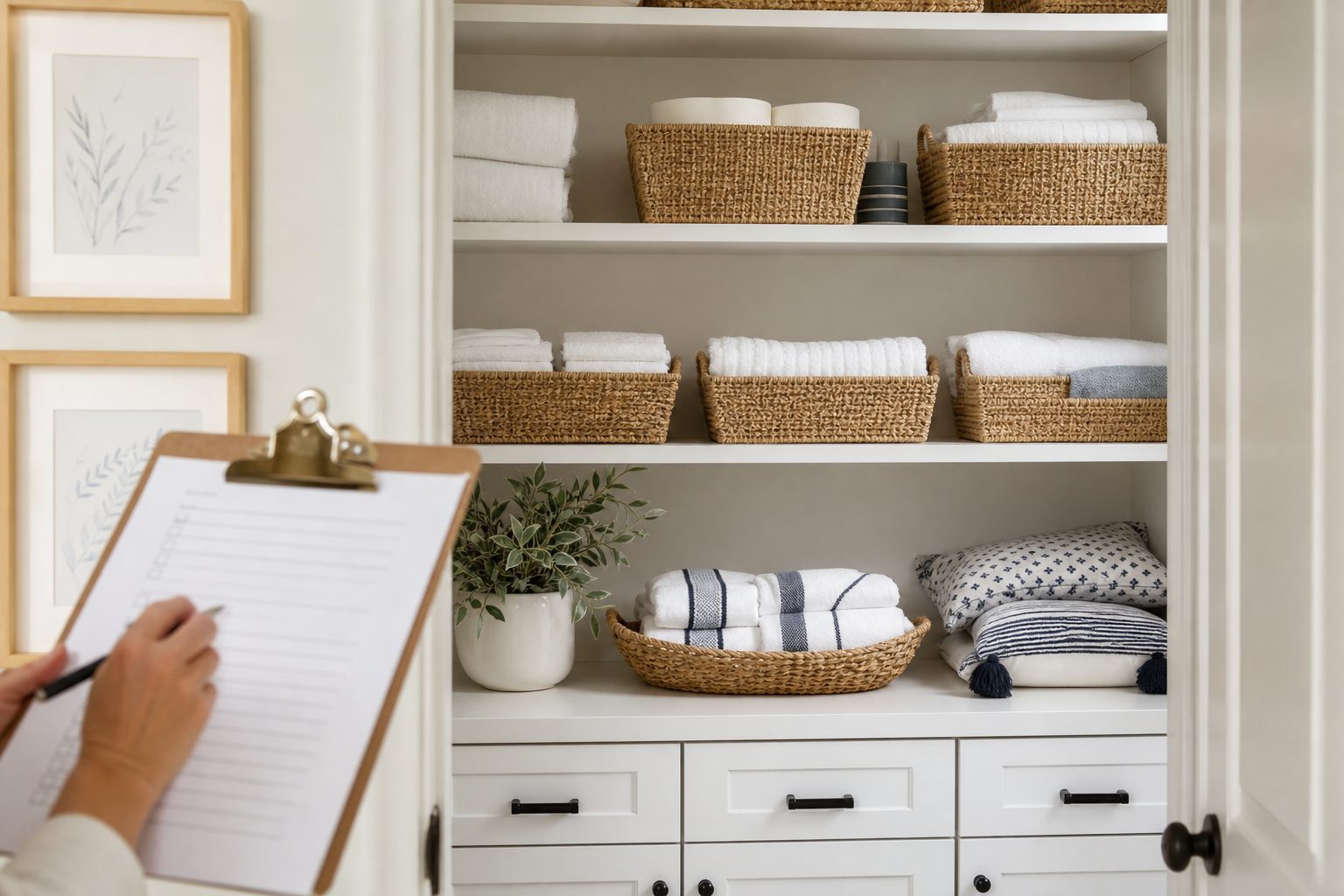
- What is the done state? Write it as a sentence the client would recognize: "Every item in the linen closet is categorized, contained, labeled, and reachable without a step stool for the top three shelves."
- Where do overflow items go? Every zone produces items that belong somewhere else. Name that destination now, or it becomes an unpriced zone later.
- Is there a decision density problem? A garage is enormous but low decision. A home office with 20 years of paper is small and brutal. Zone size in square feet is nearly useless as a predictor.
A typical whole home breaks into 9 to 14 zones. Sequence them so an early one is fast and visible. Pantry or linen closet first, paper and sentimental last, after the client has built decision stamina and trusts you.
Keep reading: How do I run a consult so the client signs the plan before I leave the house?
Cash flow and deposits under each model
This is where the two models separate hardest for a solo owner.
| Hourly | Zone flat fee | |
|---|---|---|
| When you are paid | After each session, or against a prepaid block | Deposit at signing, then per zone or per milestone |
| Cash before you start | Often none | Commonly 25 to 50 percent of the plan |
| Product purchasing | You float it or the client shops | Product deposit collected with the zone |
| Cancellation exposure | Lost day, no revenue | Deposit and cancellation terms already signed |
| Forecasting next quarter | Guesswork | Signed plans give you a backlog number |
Work an example. A twelve zone whole home plan totals $18,400 in labor and $6,200 in product. Under a zone model with a 30 percent labor deposit and full product deposit, you collect $5,520 plus $6,200, which is $11,720 before install week. Under hourly you collect nothing until the first session ends, and you have $6,200 of containers on your credit card. Same job, wildly different November.
That deposit is not just comfort. It is what lets you hire a second organizer without a line of credit.
How each model handles scope creep and decision fatigue days
Every whole home job has a day where the client hits a wall. She sits down with a box of her mother's letters and the session stops being organizing.
Under hourly, that day is financially fine and relationally awkward. You are paid, she knows she is paying, and she apologizes for crying on your clock. Some clients rush themselves into bad decisions because the meter is running, and rushed purge decisions produce regret, and regret produces bad reviews.
Under zone pricing, that day costs you. You absorb it. But you also handle it better, because you can say honestly that today is included and there is no clock. Then you build the absorption into your estimate: add a contingency of roughly 10 to 15 percent of estimated hours across the whole plan, concentrated in the sentimental and paper zones.
Scope creep is the other beast, and it is not the same thing. Scope creep is the client asking you to also do the guest room closet while you are here. That is not fatigue, that is new work, and it gets a change order.
Keep reading: Why did my closet install go three days over, and what should I have caught at scoping?
Staffing a team when the clock is not the unit of sale
Hourly pricing quietly punishes you for adding people. If you bill $110 per organizer hour and pay an assistant $28 plus payroll costs, your margin per assistant hour is real but thin, and every efficiency gain from having two hands reduces the hours you can bill.
Zone pricing inverts that. The zone is worth what it is worth. If a two person team finishes the kitchen in 9 hours instead of 15 solo, you earned the same revenue in fewer calendar days and paid out 9 assistant hours to do it.
Run it. A kitchen zone quoted at $1,650.
- Solo, 15 hours. Revenue $1,650. Labor cost: your own time. Effective yield $110 per hour, and the job occupies two calendar days.
- You plus one assistant, 9 hours each, 18 total organizer hours. Revenue $1,650. Assistant cost at $28 plus roughly 15 percent employer burden is $32.20 per hour, so $290. Your net is $1,360 for 9 of your hours, a yield of $151 per hour, and it is done in one long day.
The assistant made the job better paid per owner hour and freed a day for another consult. That arithmetic only appears when the unit of sale is the zone. Those wage figures are illustrative, so substitute your own rates and your state's employer costs.
Change orders: the clause that makes zone pricing survivable
If you take one thing from this, take this section. Zone pricing without a change order process is a slow bleed.
Write into your agreement, in plain language:
- The plan lists the zones and the done state for each. Anything not on the list is not in the price.
- Added zones are quoted before work begins on them, in writing, even if writing means a text message the client replies "approved" to.
- Volume assumption. State the assumption the estimate rests on, for example that the client will participate in purge decisions and that the volume is consistent with the consult walkthrough. If volume is materially higher, the zone is requoted.
- Overflow items discovered in one zone that belong in an unpriced zone are boxed, labeled and staged, not organized.
- Client delay. If the client is unavailable for decisions and work stalls, the session still counts against the schedule.
Say it out loud at the consult, once, warmly: "If you decide you want the garage added, that's easy, I'll send you a number for it and we slot it in. I just never want to surprise you with a bill." Clients respond well to this. It reads as competence, not defensiveness.
See how TidyBlueprint handles this for professional home organizing
Choosing a model per client instead of per business
You do not have to pick one forever. Pick per engagement, using a rule you can apply in the first fifteen minutes of the consult.
Quote hourly when:
- The client cannot let you see the whole space, or you are quoting from photos only.
- There is hoarding level volume, or an active estate or divorce, where the decision pace is genuinely unknowable.
- The client wants maintenance sessions, quarterly resets, or coaching rather than a transformation.
- The scope is one small space and the estimating overhead is not worth it.
Quote by zone when:
- You walked the space and opened the closets.
- The client wants an outcome and a timeline, and asks how long the whole house will take.
- Product is a meaningful part of the budget and needs planning.
- You want to staff it with a team.
The hybrid that works best on whole home jobs: zone flat fees for the defined spaces, plus an hourly rate published in the same agreement for added work and for the sentimental and paper zones, which are the two that resist estimation. The client sees one document with both numbers and understands exactly which is which.
Where to take this next
Zone pricing lives or dies on the quality of the walkthrough. If you can measure, count and define the done state for each space while you are standing in it, and hand the client a priced plan with a product list and a schedule before you leave, the model works. If the scoping happens later at your kitchen table from memory, it does not.
That is exactly the job TidyBlueprint does: scope room by room during the consult, attach hour estimates and product lists to each zone, build the schedule against your team's availability, and produce a signed plan on the spot with change orders that update it cleanly as the project moves.
Try it on your next whole home inquiry. Draw the zones during the walkthrough, write one done-state sentence per zone, and see whether the client signs faster than she ever did for an hourly rate card.